Monday, May 30, 2005

Mango

Without question, one of the most enjoyable things about being in Southern India is the year-round availability of regionally cultivated, tropical fruit. Currently we are at the height of mango season and wherever you go, there are mangoes being consumed. Wiry men with bare feet push carts loaded with yellow ripe fruits around the neighborhood, restaurants tout their ‘fresh mango juice’, and visitors arrive with two or three large fruits in tow. This is the time, as many home gardeners know, that creativity trumps all as you struggle to find different ways to beat the race to spoilage. Just in the last week, belying our ‘rookie mango status’, we accumulated over 10 without even trying! Fortunately, we all like it…and it’s nothing like the other Mangos that we like.

I can remember my grandfather telling me stories about his time in the South Pacific when he was in the military, eating mangoes and reacting with a severe rash, which he likened to coming into contact with poison ivy. Fortunately, for Kaia and I, this allergic reaction was not passed along. If you have ever tried to cut a mango, they are not so easy to slice up, especially the ripe ones. After paring off the skin, you end up with all different sized strips or chunks and, as the large seed clings tightly to the flesh, you are often left with a sticky, juicy mess—perfect for a two year old with impatient hands and a love for fruits to amplify ever the more.

Yet, if you were to watch me finish off a mango after slicing it up, you might think that I was the toddler, considering how I suck and slobber all over the large seed, gnawing off what I think is the tastiest part of the fruit—that which has clung to the seed. Kaia has often watched me with the kind of look of disbelief that is reserved for children when their parents do strange and/or embarrassing things. There will be more of these looks, I am sure.

Why I Love this Time: A small stuffed animal cat, which he has named “Jaggie”.


mangos! Posted by Hello

all mine! Posted by Hello

Thursday, May 26, 2005

Temper

For me, to say that one ‘loses their temper’ is a misnomer. In fact, what is much more accurate, albeit a subtle difference, is that you FIND it. Tucked deep away under the multiple layers of socialization and discipline, it is rare to find a situation where this emotion emerges without some degree of associated damage that you later feel terrible about—an unwelcome visitor, the vestige of some unresolved issues, and ripe for armchair psychoanalysis. As someone who has a closer relationship with their temper than most (read: I certainly haven’t lost it, as I know exactly where it is), one aspect of my parenting has been to try and demonstrate to Kaia a more calm and peaceful way to approach problems and situations. As many parents know, children learn so much from just watching you behave. Sure words matter, but young kids really get the adage, “I judge not by what you say, but by what you do”. For me, one of my fears is that Kaia will find that his temper is often close at hand as well.

Part of what substantiates my belief that this is a behavior that is learned at a young age, from watching close adults, is that my parents are very level-headed and calm people. If you were to fill football stadium seats with descriptive words and phrases about both of them, anger and temper would be sitting in the upper loge alongside Bob Uecker. But, if you look at my grandparents, especially my grandmother, there you can find the dictionary entry for temper—and someone who can re-find (and unload it) at any time. I suppose that, since I spent a great deal of my formative youth at their home while my mom finished school and my dad worked, that I picked up a few skills in irrational behavior and illogical frustration. Such is the supple mind of youth.

Over time, of course, like any good subject ruled by the panopticon, my temper made like Smeagol and ran from the light of good behavior, driven down into the bowels of a forgotten land. Of course, from time to time it would emerge, fed by impatience and lack of sleep, but for the most part it was controlled and in its place. That is, until I came here and, like Bilbo Baggins, something in the cultural winds has blown the tempers’ core out of hiding. It has been refound.

The incident that catalyzed the re-emergence was the culmination of a series of frustrating episodes that were lathered up from a 100 degree heat. Kaia has never been able to nap without being carried or driven in a car and, because our ‘new’ car (notable for its selling feature of being ‘good at dodging cows’) decided to crap out a few weeks ago, this has meant that, around 130-200pm every day, I have to carry him around outside for 15-30 minutes to get him to go down. Not so bad if you’re living in Seattle, where you can enjoy the gentle breeze and 75 degree temperature, but here, where the 100+ degree heat and 80% humidity beat and squeeze you of all energy, there is little to be enjoyed. This particular day I had also been attending to a few different domestic repairs, which in this country are not a simple, nor peaceful event.

From the gas repairman who used our kitchen scissors to cut and refix the gas cable, to the mechanic who wanted to drive across town to get a Phillips-head screwdriver, to the plumber who shorted out the electricity repairing the watertank, I have come to learn a few truisms about home maintenance here: One, there is no such thing as a simple repair—I’ll repeat that again—there is NO SUCH THING AS A SIMPLE REPAIR. By this, I mean that what should take 5 minutes, might take 3 days because they forgot to bring the right parts, if any at all—that is, if they decide to show up at all. Number two, often fixing one problem creates two more—take for example the aforementioned water tank repair, which led to a shorting out of the electricity AND a hole in the door from when they removed the false ceiling to get to the tank. Number three, expect a lot of people. When I saw the electrician(s), plumbers and AC people come on the same day, and it started looking like a tea shop inside the flat, all I could think was that there was some joke about ‘how many Indians does it take to change a lightblub’ in there…

But back to the situation, the entire morning had been dealing with home repair and the car had just broken down for unknown reasons. It was hot and humid and Kaia was fussy. It was the perfect storm. All that was needed was the nudge over the tipping point.

The unwitting victim of my avalanche of temper (which is really just a conduit to anger, isn’t it?) was the driver of a compact Tata Indica car. Kaia and I were walking (I was carrying him) on the side of this very (relatively) slow street. We walked by the black car and just after we passed, I felt the bumper butt up against my left leg, causing it to buckle. It was hardly a strong impact, but enough to throw me off balance and put a minor scare into Kaia. This was the second time that I had been hit by a wayward driver (the first was a motorbike where Kaia and I were the only other people on the road), and I told myself after the first one (because I was a bit shocked at what had happened) that, if it happened again, I would be sure to let the other party know how I felt. Safe to say, it was a temper explosion.

I have never gotten that upset and started screaming at someone like I did with that person. I was yelling at him and swearing in, of course, a language that he could not understand, but I am quite certain that he felt my wrath. I slammed my hand down on the hood of his car and kept pointing at Kaia to say that I was holding a small child. To his credit he was trying to apologize, but after I slammed my hand on the car, he too got a little upset. Yet, this just made me more mad. I was not aware that I could elevate my voice and get so angry, but the fact that it put Kaia in danger pushed me to unfamiliar territory. I don’t know if it was some deep-seated, primal instinct but whatever it was, this guy felt the full brunt of it.

I continued walking, and Kaia eventually went to sleep, but there were two things that stayed with me beyond the event. The first was that how I did not regret, in any way, what I had done, or how I treated this other person. I was talking to a friend the other day about this, and I explained it as being a clear line in my mind that was crossed and that, being a parent, has really defined where these lines are. To not feel regret is to know that they do exist. The other thing was that Kaia had been there to witness the entire spectacle and, surprisingly, he did not start crying or get upset, when he most certainly knew that I was. I have no idea about what must have been going on in his head, but this definitely was papa ‘losing his temper’. Of course, in 99 out of 100 times, reacting the same way would result in more problematic consequences, and I do not/did not want to show him that this kind of behavior is normal or even acceptable. But this is a true challenge as I encounter these moments when I find my temper. How to best respond and parent at the same time? Maybe in the same way that this place has led me to re-find this temper, it will eventually lead me to a state where there is nothing left to find. Such would be par for the course in India.

Why I Love this Time: Unprovoked, big, wet kisses.

Saturday, May 21, 2005


evening puja at temple Posted by Hello

Cake #2--Steaming! Posted by Hello

Cake #1 Posted by Hello

Dinosaurs! Posted by Hello

Birthday Morning Posted by Hello

Birthday

Today Kaia turned 2. Probably the day meant more to me than him.

Why I Love this Time: The best 24 months of my life.

Wednesday, May 18, 2005


Kaia and the Ambassador Posted by Hello

Here to There

There are many ways to get from point A to point B in this city, and how you make that journey most certainly shapes how you see and experience this place. Take for example, the auto-rickshaw. In this low-riding, open-air, three-wheeler, you feel every pothole, inhale every belch of exhaust from neighboring cars and busses, interact with every stoplight beggar, and haggle over the fare with each and every driver. The buzz of the engine, the sheer amusement of swerving in and out of traffic, and the personality of each auto is something not to be missed when visiting India, however, when I am riding in one with Kaia, I often wonder if I am committing some minor form of child abuse…or at least pushing my luck that he’ll not develop some acute asthma or funky rash. After any ride longer than 10 minutes in an auto and you’re tasting the Indian streets with each breath, wearing the grime of modern transport, and left feeling the bumps of the road. Usually Kaia responds to such rides in the most appropriate way: he falls asleep.

Another common mode of transportation is the ever present Ambassador taxi. Ideally suited for the Indian road, it runs in all seasons—from the monsoon’s flooding to the high temperatures of summer—and can be repaired quickly and cheaply by just about any mechanic. While you would never confuse the tight suspension and annoyingly low ceiling with anything luxurious, it is nevertheless a good way to get around in the heat of the day. But unlike the way that being in an auto rickshaw puts you in intimate contact with the road, the Ambassador is just a bit more separated. Dark tinted windows and the positively chilling air from the AC (not to mention the padded walls and ceiling, sometimes with flashing lights!) effectively shield you from much of what goes on outside of the vehicle. Beggars take less time to try to look in through the windows and you can hardly smell anything, what with the sub-zero air swirling around the cabin. Yet, the sturdy and resilient Ambassador is typically not well equipped for city travel with an infant. Kaia enjoys sitting on my lap and, when parked, playing around with the Ambassador’s dashboard and steering wheel, but the lack of seatbelts make it a poor solution for day-to-day travel.

Because we need a vehicle on a regular basis, and we have child safety concerns burrowed deep into our outlook, we decided to purchase an Opel Astra. I wont get into the crappy situation that we got ourselves into with the purchase of this vehicle (although, replete with adultery, deceit and swindling, it does make for good conversation over a beer), but for the purposes of this entry, it was a smooth, safe option that (at the time) made good sense. Now, with the purchase of this car also came a full-time driver with over 15 years of maneuvering the madness of the Madras street. A very kind and quiet man, Lingappan—or at least his ability to avoid accidents—reminds me frequently why I have no interest in getting behind the wheel in this country.

Perhaps what symbolizes more than anything the way that having a nice, private vehicle in this city does to your interaction with what is going on around you, is captured on your glasses, in the moment that you exit the car. After being ensconced in an air conditioned environment, with padded seats and a nice suspension, it seems far away from the visceral experience in riding in an auto rickshaw. But the moment you open the door, the temperature difference surrounds you and your lenses become as foggy as can be—you cannot see anything but blobs of color, effectively you are blind to what is happening around you. This is one of the tensions that you grapple with here on a regular basis as a foreigner who can afford certain luxuries far out of the reach of most Indians. For us the decision was determined almost entirely on Kaia’s safety. After crossing my fingers every time I stepping into an auto, to see him buckled into his Britax Roundabout, overcomes any sort of guilt that might creep in. Yet, this is not to say that it isn’t there. As I said to open this piece, how we get from point A to point B in this country says a lot about who you are. I guess in my case it I am telling others that I am obsessed with Kaia’s safety….if they only knew what they tell us in the States….

Why I Love this Time: Puppet shows.

Wednesday, May 11, 2005


Joyce and Kaia Posted by Hello

Help

Prior to coming here, and even for the first month or so, I was certain that I could maintain my sanity—and write a dissertation--while meeting all of Kaia’s needs, tending to domestic chores and preparing meals. Perhaps, in my entire life, I have never been more deluded. With the intense demands upon my wife from her work and the tedium of trying to get things done here in a modestly efficient manner, heaped upon the everyday tasks of washing clothes, cooking food, cleaning the house, and on and on, by the end of last month I was a complete wreck. There is no small coincidence between the silence in my postings and the tremendous toll trying to manage this household and Kaia by myself, in this country, has had on my ability to think and communicate. I was seriously starting to lose my mind.

But as fortunate would have it, one evening at the nearby (authentic, but expensive) Japanese restaurant, the manager struck up a conversation about how we were doing in our life in Madras. I communicated to him about, perhaps, needing someone to spend a bit of time with Kaia during the day, just to help to give me some time to clean and cook, much less relax and write. He said that he might have the right person in mind. He would talk to her and pass along our number, if she was interested.

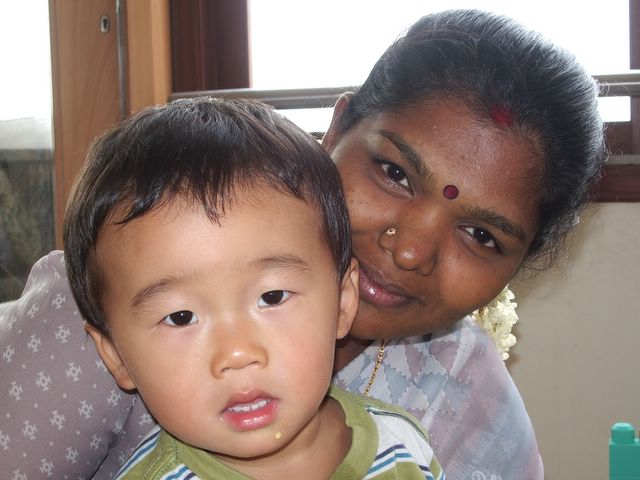
A few days later, a woman called and introduced herself as Joyce, a mother of three children, two girls and one boy, ages 11, 8 and 3. She had been working in the homes of expatriates for over 20 years and her English was impeccable—likely better than mine after a long day of babbling with Kaia. After inviting her over to our home for an interview, it was decided that we would do a one week trial period to see how Kaia and her got along. While I found her to be very sweet from the moment that I met her, one of the reasons that I have been so reluctant to hire domestic help is that I did not want to ‘manage’ them. It is very common in Madras to have domestic ‘servants’ (as they are called here) working in some capacity in people’s homes. It is said that the easiest life for any South Indian is that of the upper-middle class wife. She does not have to even lift a finger in regard to cleaning, cooking, shopping, childcare, laundry, ironing, you name it. All she has to do is manage the help. Perhaps it was my discomfort with being even associated with this kind of lifestyle, or the idea of someone calling me ‘sir’ that, even in the face of impossible labors on my time and mental health, led me to think pessimistically about this situation working out long-term.

We decided that, given the size of our apartment and the time that we needed help, Joyce would work ‘part-time’, which in these parts means from 9-3, Monday-Friday. Many domestic jobs require the women to be there from 8-6, or even later, six to seven days a week. This is considered to be full-time and, for this, the typical pay is 2,000 rupees a month, or about $45. If you do the math, it is about 19 cents an hour. A very difficult wage to rationalize, but person after person admonished me to ‘never pay more than 2,000’. This was going to be a problem for me.

As someone who is a firm believer in the baseline principles of a ‘living wage’, more than doing the currency calculations and comparing the costs of such services in the US or Japan, it would be important to ask Joyce what she considered to be fair and appropriate. She said that she was typically paid 4,000 rupees a month for full-time work (60 hours a week), and that this was good for her. Since we would not need her on a full-time basis, I suggested that we pay her 3,000 per month, plus 600 in travel expenses for bus and the occasional auto rickshaw. By this metric, she receives about $70 per month, but at around 60 cents an hour it is over three times the amount that an Indian family would pay for her work. Still it is not much, but she is happy, and in the economic structure of domestic help, she is most certainly in the upper tier of compensation. We also have helped with her children’s schooling with 5,000 rupees and, typically, will give one month’s salary during Pongal, the most celebrated holiday in these parts. Something that I have truly learned here is how tricky and contextualized the issue of fair compensation can be. Because we are being paid in US dollars, there are times when we will compare wages to others working in the US (often they are higher), but of course, here it allows us to live in an apartment across the hall from the President of the Meridian Hotel in Chennai. Unlike Japan or the US, where inequality is often hidden behind layers of materialism and silence, here it is right in your face, often literally as you look into the eyes of qualified, hard-working people with similar priorities, and realize that you will make more in one hour than they will make in one month.

Inevitably for me the issue comes back to the question of how you address these issues with your children. Of course, Kaia is far too young to have this conversation with, but there is something to be said for practicing humility and respect, and ensuring that it is clear that this wealth we have is truly a great privilege and something to be stewarded with the utmost modesty. What amounts to nickels does count for something with many people here, and it is not just those who are begging professionally on the street.

So long story short, Joyce has been a real godsend thus far. Just in the few weeks that she has been here, I’ve been able to write, think, rest and recover—things that seemed to far away just a short time ago. Asking for help is not the easiest thing to do, but there is something quite liberating in the act. Living here, I anticipate that I’ll be doing it more and more.

Why I Love this Time: Hearing him say ‘frog’, pronounced in Kaia language as ‘fuh’ga’, with an accent over the ‘uh’.

Tuesday, April 19, 2005

Play Group

About two weeks into our time here, some friends with a young boy close to the same age of Kaia invited us to join a playgroup, commonly referred to here as a ‘school’. Children attend with their parents (always the mother, grandmother or domestic helper) for one hour, in a program that runs three times a week (usually called something exclusive like ‘mother and me’ or toddler-mother morning’, and I was looking for something like this as a good activity for us to do together as well as to see a side of everyday life in India that would certainly provide fodder for this weblog…and provide it has.

I want to say first off that the people at this school were all very nice. They treated me, not as an oddity in both culture and parenting role, but as a legitimate caretaker, which is not always the case. I want to say this because the six week experience of attending this group with Kaia was very interesting for me, both in better understanding and listening to Kaia and in following my parental instincts, which seem to be getting a bit less hazy.

This particular playgroup claims to be one of the more innovative in the city, supposedly using a curriculum that encourages children to develop a broader set of sensory skills in their development from infant to toddler to little person. Yet, something that I have learned after three months of living here is that there is often a significant gap between what the ‘packaging’ says—whether it be a restaurant claiming it has a menu of ‘global cuisine’ (read: using ketchup as a tomato sauce) or a business stating that ‘customer service is our aim’ (read: maybe we’ll answer your phone calls)—what people say and what really goes on are often two different realities. The case of the play group was no different. If you were to go off of the brochure and signage, you might think that your child would experience activities that were intentional, while cultivating their curiosity thorough their playing with simple, yet provocative toys. Well, if you did, you’d be disappointed, much like you would for getting your hopes up of actually having authentic red sauce on your pasta. At this play group about the only thing that seemed innovative was the fact that they had birds and rabbits living in the same cage, which judging from the foul odor that greeted us every Monday, Wednesday and Friday, was more out of neglect than experimentation.

Kaia is a very independent person, but he is not the type to immediately jump into a new situation, he will carefully survey the landscape, process what it going on, and then slowly acquaint himself with the various people and things. I think that it is disrespectful to thrust him into a new setting and push him to adapt before he is ready (this is especially the case with his interaction with new people). But, unfortunately, the Director of the school doesn’t share my philosophy on this, or some other important matters like how to re-direct toddler violence.

For those who know Kaia, they know that he is not an aggressive child. He is an observer and is, usually, very gentle. So, when a few boys in the school, in separate incidents, started grabbing and hitting him—mind you these are 18-22 month old children—it came as an enormous shock to both him and me. The mothers were mildly apologetic and grabbed their sons with a ‘no hitting, say you’re sorry’ shallowness that belied the probability of it being the hundredth time they’d said it. What really pushed me over the edge, however, was when Kaia was playing with some toys and a small boy walked up to him and assaulted him in a way that, were he 18 years older, would have landed him in prison.

I watched as the boy, in premeditated fashion, skipped across the room and belted little Kaia in the side of the head with his open fist from behind. Kaia was so stunned that it took a few seconds before he know what had happened and began to cry. Fortunately, it was clear to me that he was not injured, so I could calmly sooth him while the mother scolded her child and then pushed him along.

Now, I am not so naïve to think that children are not susceptible to these kinds of things, even at such a young age, but what chaps me is how adults respond to these outbursts. Grabbing the aggressor’s arm and briefly scolding him—while he harfs down his second piece of birthday cake (this is the kind of shit that they served as a ‘snack’ for these kids)—isn’t going to help redirect this child’s behavior at all. But what made this the last day of Kaia’s time at the “School for Enrichment, Education and Development” was how the Director of the school responded to my concern about this behavior, “He’s going to have to learn that this is the way it is for boys”. Even as the last words blew out of her mouth, I was gone. Alternative school, my ass. It is this kind of Social Darwinian approach to education that really turns my stomach.

This episode, however, took me to a place that I had yet to explore as a parent—the feeling of regret when you sense that you have made a poor decision for your child. Kaia never chose to attend this school, and I should have been more sensitive to the ways that he was communicating to me about going there (clinching tight to me from the time we would walk through the school gates).

But what sealed the deal for me was when a few days later I asked Kaia if he wanted to go back to school. At that moment he was occupied with a puzzle, but he looked up at me, looked me straight in the eyes and waved ‘bye-bye’. There was no doubt.

Why I Love this Time: I know that I can understand him better than anyone in the world.

Sunday, April 17, 2005

Potty Training

One of the unique things about being a parent is how you come to celebrate milestones that, were you not a parent, would never come into your field of vision. Such is potty training and the monumental development marker that accompanies the regular and uncoerced act of your child sitting on a miniature toilet and relieving themselves. While there is still sometime before little Kaia is making friends with his own porcelain throne, we can confidently mark the calendar today as the first day of the rest of his post-diaper life.

Since we moved into our new flat, Kaia has been spending most of his indoor time with a look that, at two years old, gets nothing but smiles, and at twenty years old, gets you on a website: t-shirt and no pants. In fact, I am a bit envious of him being able to run around with his naked bottom in this hot weather, and the way that he parades around, he knows it is a good time. The reason that we can afford to have this pooping and peeing machine cruise around ‘unprotected’ is that most homes here are wall-to-wall tile flooring, and clean up is very easy. We moved in the first of the month and the first two weeks have been, shall we say, messy...but no permanent mistakes.

For some time we have been traveling with a small plastic Baby Bjorn toilet, literally carrying with us the hope that Kaia would demonstrate his competence for controlled continence sooner than later. The little potty doesn’t exactly pack well, so it has been a bit of a hassle to lug over three countries, but after today it all seems worth it. Seeing the little guy interrupt his reading session, pause, stand, locate the potty, walk over and sit, all on his own, well, it can bring a little tear to your eye. Like I said before, only a parent could find emotion in watching your child relieve themselves.

The merriment afterwards may be part of the reason that, it seems, Kaia is pooping and peeing more than usual. Of course, how would we know when he is in diapers, but with each movement comes a wild celebration of hoots and smiles, and I can’t recall him ever appearing as proud of his work. He may go on to become a great artist or composer, but I don’t think he can ever match the pure joy that lifts him up from his tiptoes to floating in the air. Similarly, my own hugs and grins could hardly be more filled with pride.

Why I Love this Time: Climbing to the roof of our building to watch the sunset together and, while the sun descends into the Chennai pollution, he turns to look over the ocean and says, ‘papa, moon’.

Monday, April 04, 2005


the park Posted by Hello

Anticipation

It recently occurred to me while surveying yet another park with the usual collection of rusted swings, slides with jagged edges, and the ubiquitous broken glass, that watching a toddler is much like I would expect the work of a Secret Service agent to be. In the same way that these folks are constantly anticipating what dangers might lie ahead for the people that they are protecting, life with Kaia is always looking and thinking what is in his path. In fact, it is this never-ending attention to the present and future that makes me the most exhausted.

There is a scene in the movie, In the Line of Fire, where an older Secret Service agent named Frank Horrigan (played by Clint Eastwood) is struggling to keep up with the president’s motorcade as he runs alongside. He has pushed and pushed to be placed in this post, but as the younger agents do their job with the physical ease that comes with youth, it is clear that the better days have passed him by. Sometimes I feel like this. Especially when I am carrying a 20 pound backpack filled with water, toys, food, tubes of stuff, etc. and chasing after this rambunctious little critter who wants to climb an 8 foot ladder to go down a tubular slide that has a gaping hole in it mid-way down. I wonder what it must be like for parents who are 10 years younger and who don’t have chronic injuries from the glory days of high school athletics…

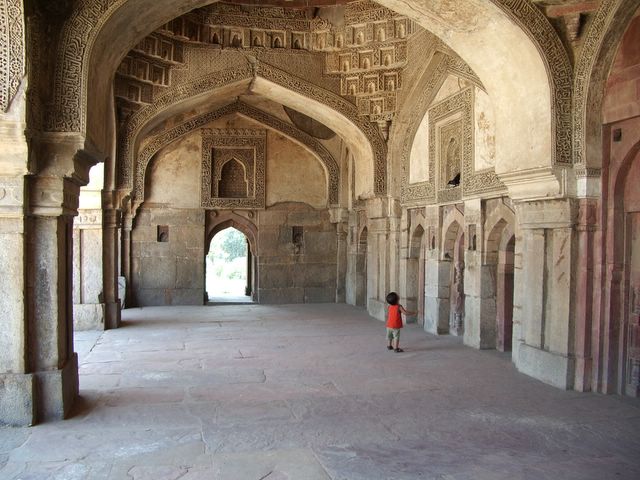
But what Horrigan lacks in stamina, he makes up for with the experience to see and anticipate things that younger agents overlook. I don’t know that I have developed any more of a spidey sense that the next parent, but yesterday, when we turned the corner of a staircase at a monument in Delhi (I guess I may need to re-title the subheading of this blog) and a rusted nail was sticking out a few inches, right at Kaia’s shoulder level, the effort to whisk him away from the path of danger was as smooth as could be. The Baby Secret Service would have been proud.

But more than any kind of life experience that you bring to parenting, I think it is the time that you spend with your children and developing a deeper connection that somehow allows you to sense danger. It is really wild. Sometimes I can have my back turned to him and I just know that he’s into something that he shouldn’t be…like picking up food wrappers off of the ground or putting things in his mouth.

Why I Love this Time: How with each day he says one or two new words. Yesterday it was “book” and today it was “ouch”.

Friday, April 01, 2005

Trip to Delhi


Our Hotel Posted by Picasa

Chasing a Crow Posted by Picasa