It has been a hard week. My wife went to
 Why I Love this Time: Shirts with names “grandme shirt”, “surfer shirt”, “ant shirt”, “chickie shirt”, etc.
It has been a hard week. My wife went to  Relatively speaking, Kaia does not watch many videos. While he can sit for a good hour or two, it is not something that he consistently pines for, or at least, if he does, he can be re-directed quite easily. Currently, I’d say that he watches about 45-90 minutes, once a week, which we have taken to calling ‘special video time’, and generally is late on Friday afternoon when I’m burned out from the week and need to bridge the gap until my wife comes home. He seems to understand this, but there are times when ‘special video time’ needs to rescue indiapapa.
One of these times was yesterday. With my wife currently in
Kaia: Watch Bob? Watch Bob?Now I know that the intentions are rather subtle here, but it was so funny to me that he was actually trying to bargain with me that I had to laugh. It seems like, as his language and development takes off, that there are lots of these moments where you cannot help but chuckle at the actions of your child. How did this little guy, who just a few weeks ago was saying ‘no’ to everything, now understanding the proper context for negotiation? I’m sure I’ll look back on this moment with nostalgia when he’s 13 and asking me to stay out just an hour later or 16 negotiating for the car.
Indiapapa: How did you remember that? No, Kaia. No more videos.
Kaia: Please papa…just one? Just watch one?
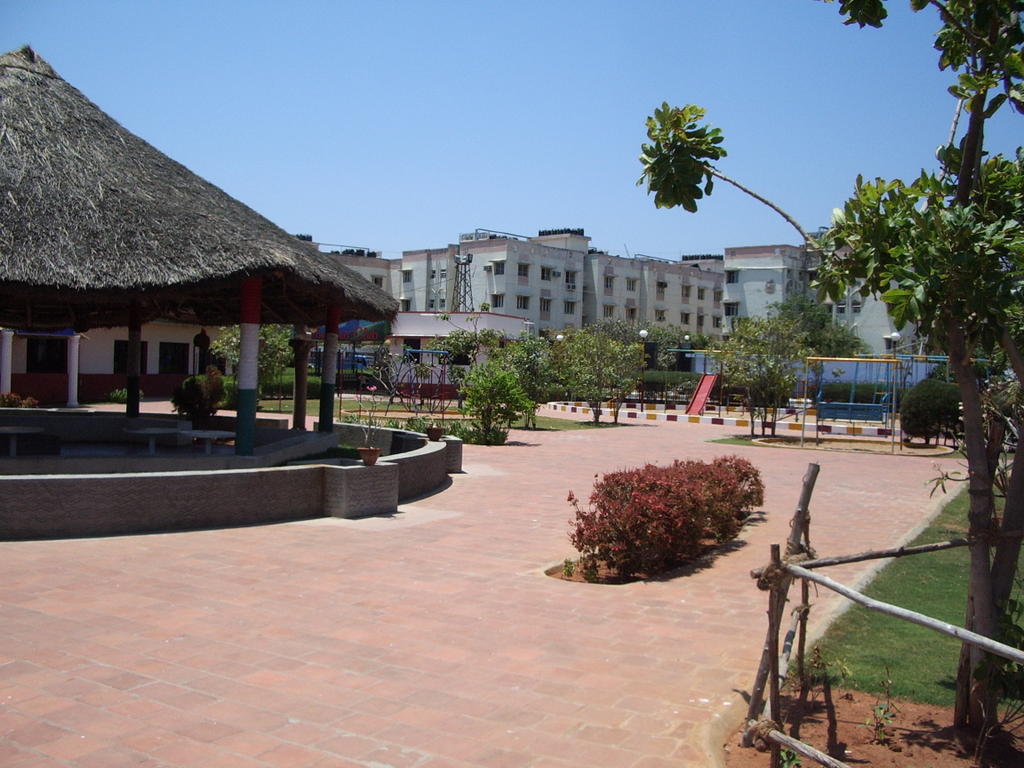 Something that I did not expect to do when we moved here was to join an exclusive club. I had heard about the lingering vestiges of British colonialism here in Chennai, like the Madras Club, where elite gather to sip imported whisky and scoff at the imperfections of Indian life, and wanted nothing to do with it. Call me an ex-pat snob, but it has never been my interest to seek out fellow Americans when living abroad, although I would be lying if I said that I didn’t enjoy those few times when I have commiserated with fellow Yanks, particularly for the tips on places to eat and shop. But the kind of scene that I imagined at an elite club, in a place like
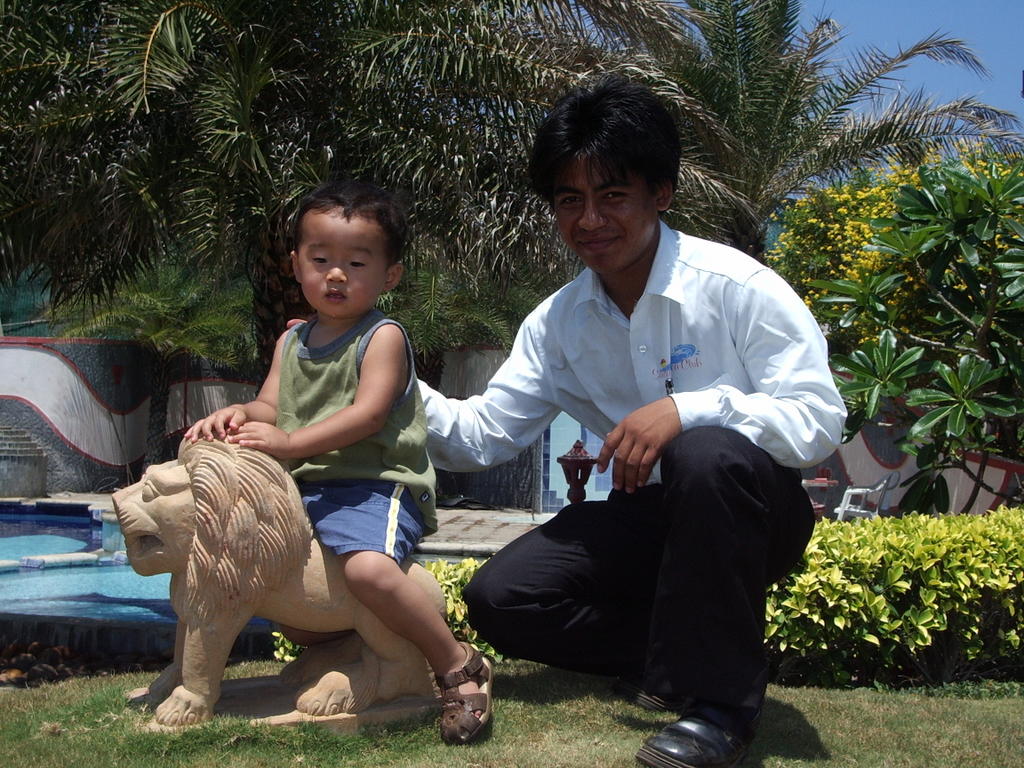 While the club is open from 8am-11pm, most of the members come in the evening time. They show English, Tamil and Hindi movies on the weekends and lots of folks come for the open-air showings and enjoy dinner at the same time. Kaia and I, however, visit in the late morning, when there is nobody, except for the Sindur staff, whom we have come to know very well. There is Satish Kumar (like our old cat!), the General Manager of the club who grew up in Kenya, Shanmugam, the pool maintenance man, who keeps a great pool, Dinesh, the bar/game room person, with the 4 inch pinky fingernail, Padham (at left with Kaia), the young Nepali, Silvi, the cleaning woman with the distinct “Kaiiiiyyyaaa”, and on and on. Because, when we visit, we are generally the only guests there, it has become a very nice place to come back to each time.
General Manager (10,000 rupees/$230)If you consider that, on a given day, there are about 3 supervisors working (restaurant, bar/game room, exercise room), 4-6 waiters, and 6-10 cleaning folks, that would make for a total monthly expenditure of around $1,400. That’s 22 people, full-time. And you wonder why companies—not to mention large corporations--come to places like
Assistant Manager (6,000/$140)
Bar/Game room supervisor (3,500/$81)
Waiters (2,500/$58)
Poolman (2,500/$58)
Cleaning people (2,000/$46)
 loor puzzle of nursery rhymes. For some months he had been doing the types of board puzzles that captures toddlers’ attention, but for some reason he decided that he was ready to tackle the interlocking kind. It was quite remarkable to see how quickly he learned to place all of the pieces and so cute to see his pride emerge upon placing the final piece. Ever since mastering this one, he has this hunger for new puzzles and can sit for well over an hour putting them all together.
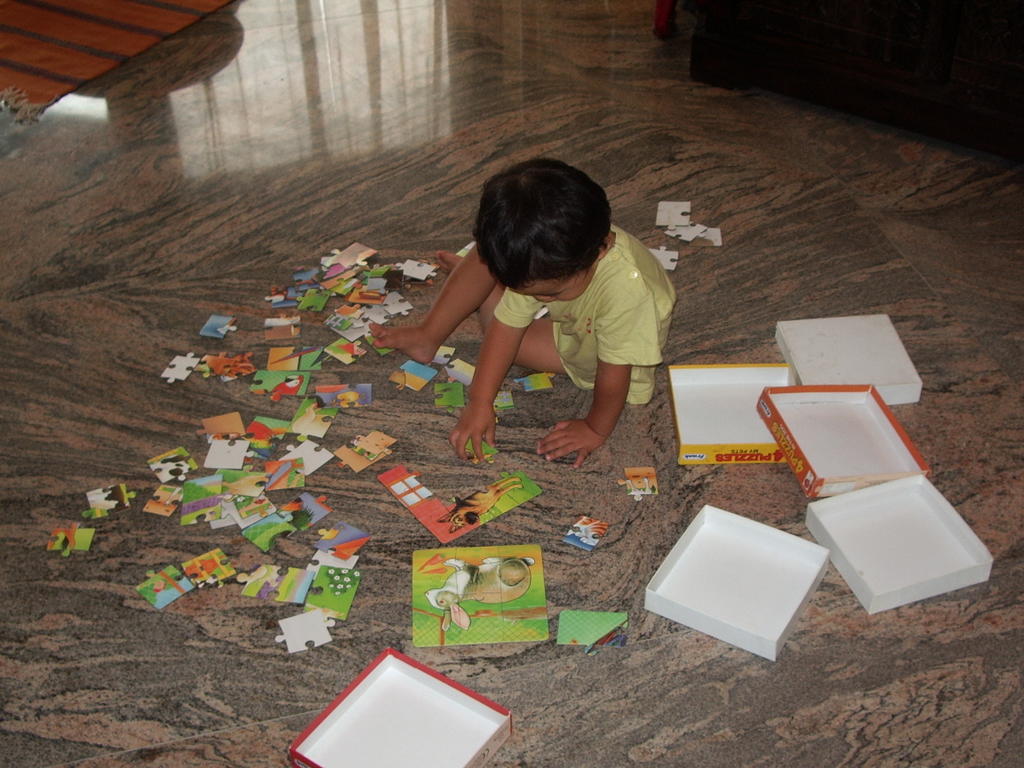 exhibits, scanning the available pieces and considering the options, turning each piece multiple times, is something that I’ve learned a lot from. There is this certain confidence that he has, knowing that the puzzle will eventually come together, and that at some point the challenge become easier as the pieces, literally ‘fall into place’. But, in the beginning, it is a matter of trying to put together combinations, and not losing faith and falling into frustration. As time goes on, the path to completion becomes more clear and, when that final piece is placed and the full picture comes clear, there is time for a clap and a smile, and it is on to the next one. For me this persistence is such a life lesson -the challenge to forge ahead when the answers may not be so clear. This is but one thing I’ve learned at the foot of the little puzzle prince.
After a two and one-half week break, Kaia went back to school at Kids Central today. It seems like so long ago that we first took him there and all of the anxiety that accompanied that event. Today was so smooth—no tears, no clinging, just a brief wave bye-bye and off he went. Since it was a new term, there were a few new children in the group and you could certainly tell who they were. Just as I was exiting the school, I saw a mother whom I had briefly met last week bringing in her son (born on May 20, one day before Kaia) into Kids Central for the first time. He was, predictably, wailing and wrapped tight around his mother and she looked even worse than he did. She had told me when we spoke that this would be the first time that he was going ‘to school’, so she was concerned about how it would go. From the looks of things—not well to begin with. I don’t long for those days, but it is fascinating how quickly the human condition adapts and moves forward. All of the sadness and nostalgia I felt leading up to that day, and how it really gripped me, has gone into hibernation for the time being and now it is just a regular ol’ thing to drop him off. Of course, this is just a warm up act for all of the other significant detachments—first day at ‘real’ school, when he chooses friends over papa, adolescence, off to college…
 Anyway, while I don’t think that I can consciously become more aware of ‘taking advantage’ of the moment, the reminder of time’s march just reinforces my thanks for this time with Kaia. For you, dear readers, this may seem a bit overly sentimental and somewhat shallow in analysis, but there are certain times where I lack the ability (or am perhaps just lazy!) to fully articulate what it is that I am experiencing. Today I put up a photo from Kaia’s birth on my computer desktop—I’m posting it here as well—just to remind me that this little critter is going to be huge before I can even contemplate what happened. I had never before experienced the emotion of when joy and sadness tie a knot around a moment that you know is precious. Since he’s come into my life it seems like they happen on a regular basis. Hopefully by the time I’m 50, and he’s 17, we can look back on this entry and experience the same joyful walk down nostalgia’s lane.
Oh, Zingerman’s! And time marches on....
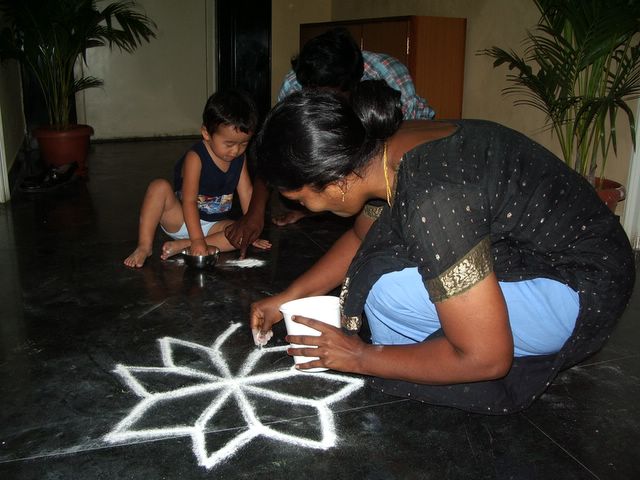
One of the more beautiful traditions in Tamil Nadu is the kolam, which refers to the decorative artwork drawn in front of homes and deities in puja rooms. The intricate symmetric designs and mandalas are a part of a long cultural tradition of south Indian families and are passed down from women to girls. They are considered to be a sort of painted prayer and often designs carry special meaning from family to family. Every morning you can see women drawing exquisite kolams in front of their homes and, by afternoon, they have all but disappeared due to wind, rain or human feet. This, of course, is part of what makes them so special.
It is hard to know how long it will last (since we’re in a flat, there is not concern about wind or rain), but with the steady stream of visitors, I’d give it about 2 days. It is great to know, however, that we’ll be making another one soon.
Of the hundreds of gods and manifestation in the Hindu pantheon, perhaps Ganesha is the most popular. Even the most uninformed and uninterested visitor to this country cannot help but notice the elephant-headed visage of Lord Ganesha on just about every auto and in every building. This week has been Ganesh Chaturthi, which is the festival celebrating his birthday. The whole event is rather ritualized and significant (while some areas do not celebrate as wildly, it is a national holiday), so Kaia and I thought that we would give it a whirl and try our hand at celebrating local style.
Our ayah, Joyce, advised us of all of the things that we’d need to get to make it right: a coconut, sugar cane, dates, bananas, camphor (for burning), a bell (to summon Ganesha), corn, a banana leaf (to place things on), dahl, and a puffed rice mixture (that Ganesha supposedly likes to eat). All of these things can be seen in the first photo. Oh, and an umbrella and flower lei for Ganesha as well. After getting everything for less than $3, we set it up. She told me how to peel one banana (in the opposite direction) while keeping the other closed and the process for doing the puja, which Kaia did a great job with—even placing the flowers and mixing the food (photo #2).
After placing all of the items in their proper place, we lit the camphor and circled it three times around Ganesha while ringing the bell. After the completion, you ‘feel’ the heat from the burning camphor and touch it to your forehead. In photo #3 Kaia is learning how to do this with a little help from Sethu. In photo #4, the process is complete with a little reverent prayer and bow and it is off to the ocean in a few days.
We did the puja on Wednesday in our home and then, on Saturday experienced the external celebration that I was particularly looking forward to. It was just a long procession of people (mostly men) shouting and chanting, carrying Ganesha statues, making their way to the ocean. The small clay statues, like the one that we had brought with us, were piled up in the back of bullock carts, presumably from regional temples, and the people were disposing of them as proxies. But what was particularly stunning was the size and elaborate décor of some of the statues. As I said before, all I could think about is—what is the ocean going to look like after this? In the final photo, you can see how they lift the larger statues with a large crane and then boat it out about 100 yards before dumping it. It must be a pretty creepy looking artificial reef out there with hundreds of Ganesha in various states of decomposition.
As expected, Kaia was thoroughly impressed with the cranes and disposal process. He’s also developed an affection for Ganesh and immediately asked when we were going to get a new one. The entire process and final event was truly memorable and Kaia really enjoyed himself. Somehow I don’t think that folks would look to kindly at us tossing elephant headed clay figurines into the