Anyway, while I don’t think that I can consciously become more aware of ‘taking advantage’ of the moment, the reminder of time’s march just reinforces my thanks for this time with Kaia. For you, dear readers, this may seem a bit overly sentimental and somewhat shallow in analysis, but there are certain times where I lack the ability (or am perhaps just lazy!) to fully articulate what it is that I am experiencing. Today I put up a photo from Kaia’s birth on my computer desktop—I’m posting it here as well—just to remind me that this little critter is going to be huge before I can even contemplate what happened. I had never before experienced the emotion of when joy and sadness tie a knot around a moment that you know is precious. Since he’s come into my life it seems like they happen on a regular basis. Hopefully by the time I’m 50, and he’s 17, we can look back on this entry and experience the same joyful walk down nostalgia’s lane.
Oh, Zingerman’s! And time marches on....
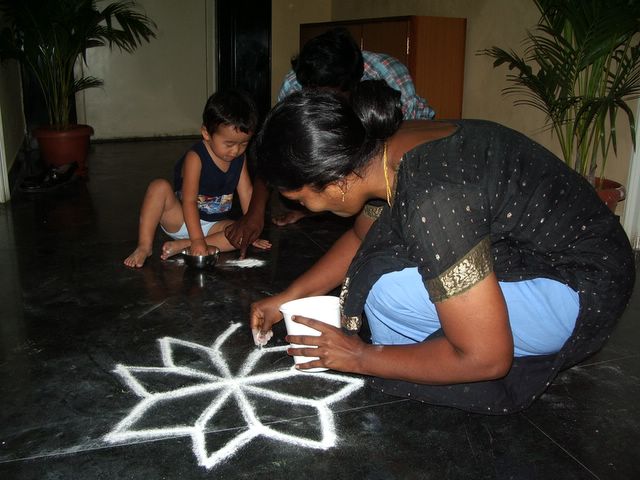
One of the more beautiful traditions in Tamil Nadu is the kolam, which refers to the decorative artwork drawn in front of homes and deities in puja rooms. The intricate symmetric designs and mandalas are a part of a long cultural tradition of south Indian families and are passed down from women to girls. They are considered to be a sort of painted prayer and often designs carry special meaning from family to family. Every morning you can see women drawing exquisite kolams in front of their homes and, by afternoon, they have all but disappeared due to wind, rain or human feet. This, of course, is part of what makes them so special.
It is hard to know how long it will last (since we’re in a flat, there is not concern about wind or rain), but with the steady stream of visitors, I’d give it about 2 days. It is great to know, however, that we’ll be making another one soon.
Of the hundreds of gods and manifestation in the Hindu pantheon, perhaps Ganesha is the most popular. Even the most uninformed and uninterested visitor to this country cannot help but notice the elephant-headed visage of Lord Ganesha on just about every auto and in every building. This week has been Ganesh Chaturthi, which is the festival celebrating his birthday. The whole event is rather ritualized and significant (while some areas do not celebrate as wildly, it is a national holiday), so Kaia and I thought that we would give it a whirl and try our hand at celebrating local style.
Our ayah, Joyce, advised us of all of the things that we’d need to get to make it right: a coconut, sugar cane, dates, bananas, camphor (for burning), a bell (to summon Ganesha), corn, a banana leaf (to place things on), dahl, and a puffed rice mixture (that Ganesha supposedly likes to eat). All of these things can be seen in the first photo. Oh, and an umbrella and flower lei for Ganesha as well. After getting everything for less than $3, we set it up. She told me how to peel one banana (in the opposite direction) while keeping the other closed and the process for doing the puja, which Kaia did a great job with—even placing the flowers and mixing the food (photo #2).
After placing all of the items in their proper place, we lit the camphor and circled it three times around Ganesha while ringing the bell. After the completion, you ‘feel’ the heat from the burning camphor and touch it to your forehead. In photo #3 Kaia is learning how to do this with a little help from Sethu. In photo #4, the process is complete with a little reverent prayer and bow and it is off to the ocean in a few days.
We did the puja on Wednesday in our home and then, on Saturday experienced the external celebration that I was particularly looking forward to. It was just a long procession of people (mostly men) shouting and chanting, carrying Ganesha statues, making their way to the ocean. The small clay statues, like the one that we had brought with us, were piled up in the back of bullock carts, presumably from regional temples, and the people were disposing of them as proxies. But what was particularly stunning was the size and elaborate décor of some of the statues. As I said before, all I could think about is—what is the ocean going to look like after this? In the final photo, you can see how they lift the larger statues with a large crane and then boat it out about 100 yards before dumping it. It must be a pretty creepy looking artificial reef out there with hundreds of Ganesha in various states of decomposition.
As expected, Kaia was thoroughly impressed with the cranes and disposal process. He’s also developed an affection for Ganesh and immediately asked when we were going to get a new one. The entire process and final event was truly memorable and Kaia really enjoyed himself. Somehow I don’t think that folks would look to kindly at us tossing elephant headed clay figurines into the
Last month, as avid readers of this weblog will recall, we hired a new driver named Sekar (pronounced SHECK-ar) from a family who was leaving
We arrived at the event about 15 minutes late, but expectedly, there were few people there at the appointed 7:00pm start time. In this country, at least in Tamil Nadu, timings are a very fluid concept, in fact they couldn’t be more different than the fascist punctuality one finds in
In the wedding hall, on the 3rd floor, the area had already been prepared with folding chairs and glittering streamers and, most importantly I would imagine, the red ‘thrones’ on the front stage, under the watchful illustrations of Ganesh (for domestic harmony and success), Lakshmi (for wealth and beauty), and Saraswathi (for wisdom and learning) where the bride and groom are to sit. I don’t know if it was a sacrilege for Kaia to be up there playing around, but all the folks who were there didn’t seem to mind!
Maybe the most enjoyable part about being in
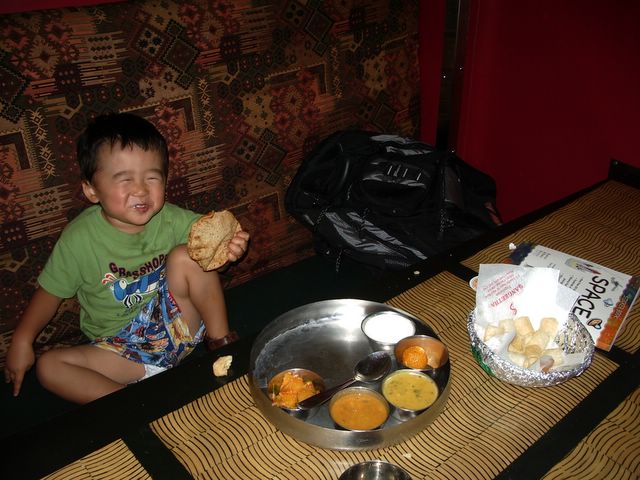
But for Kaia, the thali—in fact any Indian eating experience—has made it difficult for us to establish any kind of utensil habit. Hands are the preferred mode of transport from plate to lip and who can blame him? Food tastes much better when it is coming off of your fingertips. The challenge with him isn’t if he is going to make a big mess—he is—it is whether or not he can steer clear of the spicy things. You can tell any Indian cook not to make something spicy and this just means 1 chili instead of 4. I don’t know if it is within the realm of possibility to even cook without adding some kind of spice…it is as if there is a magnet between the hand and pan that just pulls it in. Anyway, while Kaia has a decent tolerance for spicy things (but HATES anything hot temperature wise), there tend to be little ‘bombs’ of fire that get him from time to time. In the photo above you can see Mr. Happy just moment before chomping down on something spicy that sent him off into a two minute screaming-fest. For Kaia, but the small side dishes are OK, it is the different breads and fried things like chapathi, pappad and puri that bring a smile to his face. In the photo he’s munching on a puri and the (children’s) thali plate has, from right to left, curd (yogurt), a sweet, dahl, sambar, and chili potato dish. Later on comes the ice cream. Today Kaia reached for the pan after lunch, but I don’t think that he and betel nut would be such a great idea just yet.